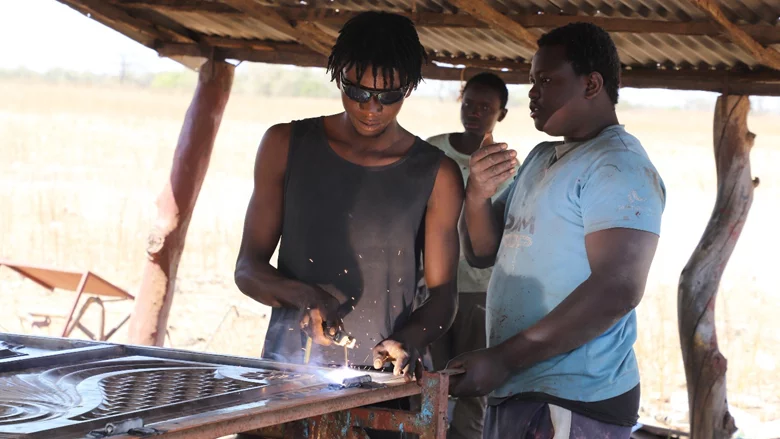

Every spark of metal used come at a price Muhammed Kandeh could barely afford. As a young welder in Jah Kunda — a small off-road village in the Upper River Region of The Gambia — Muhammed ran his welding machine on gasoil-fueled generators.
“Back then, a three-day welding job consumed about 20 liters of gasoil, costing D1,700 ($25) and for bigger contracts, I needed up to three 20-liter bottles totaling D5,100 ($75) and still made a meager profit.”
Today, things are different. Jah Kunda is one of 706 communities newly connected to the national grid through the Gambia Electricity Restoration and Modernization Project (GERMP) and the ECOWAS Regional Electricity Access Project (ECOREAP) — financed by the World Bank, the European Union, and the European Investment Bank.
Together, these projects have driven the largest electrification expansion in the country’s history, raising national electricity access from 60% in 2018 to a projected 90% today. For Muhammed, the difference is immediate and dramatic. “Now, D200 ($2.5) worth of power lasts me an entire week,” he says with a wide smile. “That changes everything.”
From Struggle to Growth
The workshop where Muhammed works is owned by long-time welder Mbakey Ceesay, who has run the business for years and knows firsthand what operating without reliable power means. What was once a small metal shop struggling to stay afloat has grown into a local employer. Today, 15 young people — including apprentices eager to learn the trade — work there daily.
With reliable electricity, the workshop has evolved from a survival-level enterprise into a growing source of jobs and skills for rural youth. These new opportunities are especially critical in a region where formal employment is scarce and where young people often feel compelled to migrate in search of work.
For many of them, the workshop is an alternative to irregular migration — proof that when electricity arrives, opportunity arrives with Muhammed sees this directly in the faces of the young apprentices beside him.
“I can work better, earn better, and take care of my family,” he says. “And I want the same for them.”
The story of Jah Kunda’s welding workshop illustrates a broader ambition. The World Bank Group is working to help the 1.2 billion young people in developing countries who will enter the workforce over the next decade access decent, well-paying jobs. Its approach rests on three pillars: investing in physical and human infrastructure — including energy; supporting policy and regulatory reforms that let businesses grow; and mobilizing private investment at scale. In The Gambia, as across the region, reliable electricity is the foundation on which all three come together, enabling local enterprises to grow, skills to transfer, and young people to earn a living without leaving home.
Cooling, comfort, and community benefits
Electricity has reshaped daily life in Jah Kunda beyond the workshop walls. For years, the workshop’s lone community-use freezer was the village’s only source of free ice blocks and cool drinking water.
“People used to come here every day for cold water, because in surrounding villages, a block of ice costs D85 — not affordable for many,” Mbakey explains. “Now with electricity, families that can afford a refrigerator can have access to cool drinking water at home. It makes life easier.”
A safer community
Perhaps one of the most significant changes is the sense of security that electricity has brought to the village. Before household lighting was available, Jah Kunda was engulfed in darkness at night, elevating risks of theft and break-ins for families and businesses alike.
For village head Alkalo Barrow, electricity brought long-awaited relief. “With power, the village feels safer. The lights alone have reduced the risks of robbery and theft we used to face — at home but also among local businesses,” he says.
Inside homes, children who once strained to study under the dim flicker of candles or kerosene lamps can now sit at their desks long after sunset. For a village like Jah Kunda, where access to quality schooling is already limited, that extra hour of light could be the difference that shapes a child’s future.
A future sparked by electricity
With lower operating costs, rising demand, and a generation of young apprentices learning the trade, Mbakey’s welding workshop stands as a symbol of what reliable energy access can unlock — new jobs, new skills, and more sustainable livelihoods.
“Electricity didn’t just power the machines,” Muhammed says. “It powered our lives.”
Jah Kunda’s transformation mirrors the experience of hundreds of Gambian communities where lives, livelihoods, and futures are being reshaped. As electricity reaches communities, local enterprises are growing, micro-businesses are emerging, and rural youth are gaining access to incomegenerating opportunities that were previously out of reach. Energy has become a catalyst not only for development — but for the kind of dignified, locally rooted jobs that help families thrive and keep young Gambians building their futures at home.
This momentum in The Gambia is part of a far larger continental push. Mission 300 — the landmark initiative led by the World Bank and the African Development Bank — aims to connect 300 million people across SubSaharan Africa to electricity by 2030. For communities like Jah Kunda, that ambition is not an abstraction — it is the grid line that now runs into Mbakey’s workshop and lights up the desks where children study after dark.