

By Mariatou Ngum & Abdou Mbye
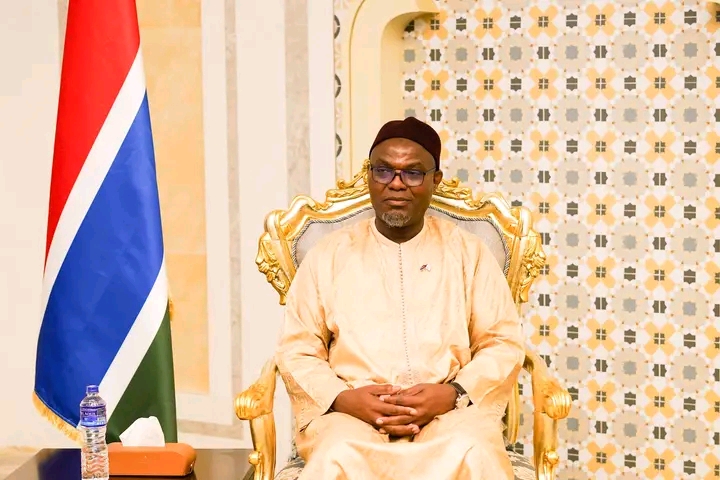
His Excellency Mohammed B.S. Jallow has called for urgent and decisive action to address the growing threat of climate change in The Gambia, warning that the cost of inaction is too high for the country’s future development.
The Vice President made these remarks during the high-level launch of The Gambia Country Climate and Development Report (CCDR) held at the Sir Dawda Kairaba Jawara International Conference Centre. The event brought together cabinet ministers, development partners, private sector leaders, civil society representatives, local government officials, and members of the World Bank Group delegation.
Addressing the gathering, Vice President Jallow stated that climate change is no longer a distant threat but a reality already affecting The Gambia’s economy and development trajectory.
“The cost of inaction is simply too high,” he said, noting that although The Gambia contributes less than 0.01 percent of global opportunities for sustainable growth. greenhouse gas emissions, it remains among the most climate-vulnerable countries in the world.
He revealed that more than 60 percent of the country’s population lives in coastal and urban areas exposed to climate risks, with flooding accounting for significant economic losses estimated at up to 3.8 percent of GDP annually.
The Vice President expressed particular concern over the vulnerability of Banjul, describing the capital city as both the economic and administrative heart of the nation and warning that rising sea levels pose a serious threat to its future.
According to the report, climate change could reduce The Gambia’s GDP by up to 9.3 percent by 2050 if urgent interventions are not undertaken. The report also warns of increased public debt pressures, slower economic growth, and rising poverty levels.
However, Vice President Jallow emphasized that timely investments in adaptation and climate-resilient strategies could significantly reduce projected losses while creating opportunities for sustainable growth.
He highlighted that since 2017, The Gambia’s economy has recorded an average annual growth rate of about 5 percent, driven by reforms and increased investments, including climate-related initiatives. Despite this progress, he noted that the country remains structurally vulnerable, particularly due to heavy dependence on climate-sensitive sectors such as agriculture.
The Vice President disclosed that The Gambia will require approximately 1.8 billion US dollars by 2030, 3.1 billion US dollars by 2040, and over 8 billion US dollars by 2050 to effectively tackle climate challenges and protect development gains.
He stressed the importance of private sector participation, noting that public resources alone would not be enough to meet the country’s climate financing needs. He also called for improved access to finance for small and medium enterprises, which account for nearly 80 percent of businesses in the country.
Vice President Jallow further underscored the need to bridge the gap between policy ambition and implementation.
“The Gambia has one of the most progressive climate policy frameworks in the region.
However, the challenge now lies in execution by translating policies and plans into tangible results that improve lives,” he stated.
Among the country’s urgent priorities, he identified the protection of Banjul, climatesmart agriculture, renewable energy transition, urban resilience, coastal ecosystem restoration, climate finance mobilization, and stronger institutional coordination.
Describing the CCDR as “a roadmap for action,” the Vice President said the report presents an opportunity for The Gambia to protect its economy, create jobs, reduce poverty, and build a more resilient and prosperous nation.
On behalf of President Adama Barrow and the Government of The Gambia, he thanked the World Bank Group and development partners for their support in producing the report and called on all stakeholders to work together in translating its recommendations into concrete actions.