
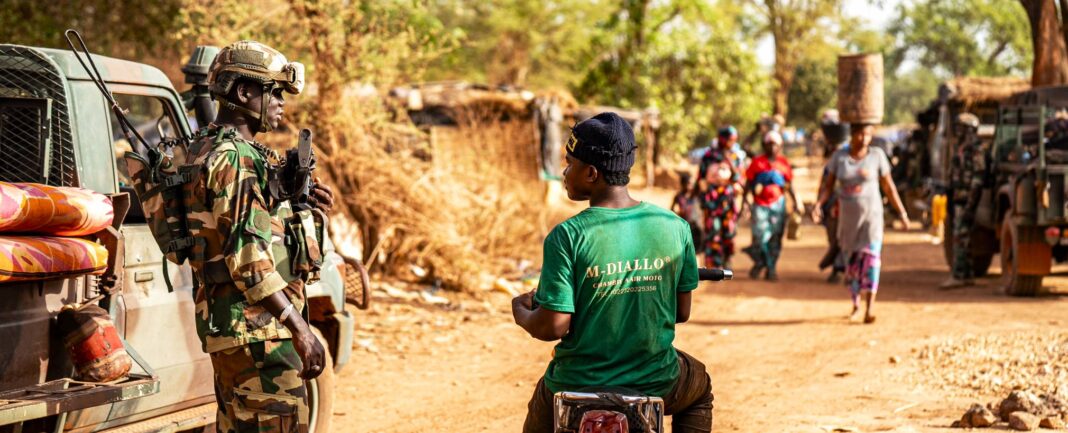

Dozens of fuel tankers traveling from Senegal have been attacked and set on fire in western Mali since the militant Islamist coalition Jama’at Nusrat al Islam wal Muslimeen (JNIM) launched an offensive in July 2025 to shut down key economic arteries supporting Bamako and other populated areas in southern Mali.
These sustained and systematic attacks have brought the militant insurgency to the border of neighboring Senegal. An assault on the customs post in Diboli, Mali, took place less than 1 km from Kidira, Senegal—a 2-minute walk to the border at the Falémé River.
Kayes, the regional hub in western Mali and the focal point of the attacks, is only 100 km from the Senegalese border. Many of the fuel trucks and other traffic that have been attacked originate in Senegal. The deterioration of security in western Mali has prompted Dakar to elevate eastern Senegal to a top security priority.
In response, the Senegalese government has expanded its military footprint in the region, including establishing one of the country’s largest military bases in Goudiry. This has been accompanied by the deployment of rapid intervention gendarmerie units known as Groupe d’Action Rapide pour la Surveillance et l’Intervention (GARSI), which have bases in nearby Kidira, Saïensoutou, Moussala, and Médina Bafé.
The growing security pressures are compounded by the displacement of an estimated 20,000 people from the Sahel into eastern Senegal, placing additional strain on already vulnerable border communities. Eastern Senegal is also shaped by longstanding cross-border organized criminal activity that further complicates the security environment.
Arms trafficking linked to illegal gold mining and drug transit routes operate across the porous borders connecting Senegal, Mali, Guinea, and Guinea-Bissau. Cross-border markets like Médina Gounass and Diaobé have long facilitated these flows, with motorbike taxi drivers (“Jakarta men”) and other opportunistic actors blurring the lines between illicit economies and everyday livelihoods.
Although these networks are not inherently violent, they increase exposure to exploitation by militant groups seeking access, financing, or freedom of movement if left unmanaged. The challenge Senegal now faces is how to prevent these overlapping pressures—militant proximity, criminal networks, and social strain—from hardening into an entrenched security threat. This is not a question of reacting to an insurgency that has already taken root, but preventing one from emerging in the first place.
Restoring Trust in the Casamance
Senegal’s experience in Casamance offers instructive lessons for how trust-based engagement between communities and security forces can help contain emerging risks. Distrust has long sustained insecurity in the Casamance, enabling illicit economies that funded the separatist group, the Mouvement des Forces démocratiques de la Casamance (MFDC), and deepened local vulnerabilities. The war economy that emerged alongside the separatist conflict entrenched drug and timber trafficking as well as large-scale cattle theft.
Casamance: Stabilizing a Fragile Region
Casamance, in southern Senegal and separated from the rest of the country by The Gambia, has experienced one of West Africa’s longest-running low-intensity conflicts. Home to roughly 1.5 million people (10–12 percent of Senegal’s population), the Casamance differs from the Sahelian north in its agrarian economy and greater religious and ethnic diversity.
Grievances linked to political and economic marginalization escalated in the early 1980s when protests were met with state force, contributing to the emergence of the Mouvement des Forces démocratiques de la Casamance (MFDC) and a separatist insurgency that peaked in the 1990s.
The conflict evolved into a protracted confrontation marked by intermittent ceasefires and localized violence. Over time, the conflict displaced an estimated 150,000 people, with tens of thousands remaining internally displaced in The Gambia and Guinea-Bissau.
Violence has included guerrilla attacks, banditry, and clashes between armed factions and state forces, particularly in forested border areas. A 2022 accord and a February 2025 peace agreement with the principal MFDC faction introduced amnesty and reintegration measures, reinforcing broader de-escalation. Although not all factions have s i gned on , t he s e developments—alongside sustained stabilization efforts—have significantly reduced insecurity across much of the region.
These illicit activities thrived in a conflict environment marked by weak communication and limited collaboration between communities and the defense and security forces, particularly along the borders with The Gambia, Guinea-Bissau, and Guinea.
Criminal networks routinely exploited local knowledge and social ties, relying on community-based lookouts and early warning to evade detection. In practice, this meant that crimes such as organized cattle theft and timber trafficking could be conducted with relative impunity in border areas where enforcement was sporadic and distrust of the security forces was high.
Misperceptions and mistrust further compounded these dynamics. Many communities had a limited understanding of the distinct roles of the police, gendarmerie, and army. Thus, negative experiences with enforcement were often generalized across all security actors. In this context, reporting criminal activity was widely viewed as a breach of community solidarity. A culture of silence took hold, reinforced by fear of reprisal from armed criminal groups. Incidents were frequently reported late—or not at all—reducing the ability of security forces to intervene effectively. In Goudomp, for example, residents acknowledged that cattle thefts were at times reported only the following morning, giving armed perpetrators ample time to flee across the border into GuineaBissau. Residents in many communities had little direct contact with the gendarmerie or army during attacks by the MFDC or other criminal groups.
Justice Security Dialogue as a Preventive Security Tool
Senegal’s experience in the Casamance illustrates that one of the central challenges in preventing the escalation of insecurity in border regions is not simply the presence of armed groups or criminal networks, but the quality of the relationships between communities and the security services.
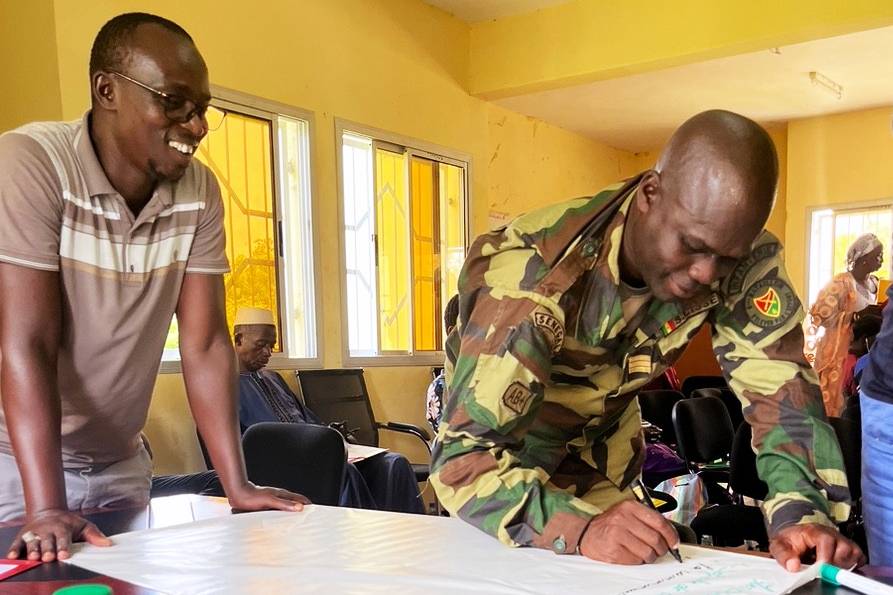
Where communication is limited and trust is weak, early warning breaks down, cooperation falters, and security responses tend to be reactive rather than preventive. These populations may also be easier to radicalize. It is in this space that the Justice Security Dialogue (JSD) has proven to be a particularly effective tool. Launched in the Casamance in 2019, JSD is a trust-building program that brings together community members, civil society organizations, security personnel, and government officials to jointly identify and address local security challenges.
Rather than focusing on enforcement alone, the approach emphasizes dialogue, shared problemsolving, and adaptation to local conditions. In many cases, JSD forums represent the first time that community leaders and security forces engage directly and constructively around security priorities.
One of the central challenges in preventing the escalation of insecurity in border regions is the quality of the relationships between communities and the security services tasked with protecting them. Through facilitated dialogue sessions, participants identify the most pressing security concerns in their communities, select problems that can be addressed locally, and develop practical responses with the involvement of security services.
These initiatives are then assessed collectively, allowing stakeholders to adjust approaches, expand participation, and gradually share responsibility for leading the dialogue process. Over time, this iterative model has helped restore confidence and establish more predictable, respectful relationships between communities and security agencies.
During the first JSD sessions, security personnel shared their direct phone numbers with community leaders—a simple but significant gesture that participants consistently cited as a turning point in improving collaboration. The absence of reliable communication channels had been a major barrier to effective security cooperation.
In response, the initiative supported the creation and distribution of contact books containing comprehensive contact information for security forces, civil protection services, local authorities, and community leaders. The widespread availability of these contact books strengthened community confidence and made reporting incidents easier and more routine.
Their practical usefulness quickly became evident, and demand for the contact books soon spread throughout Goudomp Department.